
Producing a Fast-Moving Commercial Shoot in Albania
Notes from a production manager at Caravan
We kicked off the project for **Vodafone Business Digital+ with LeSpot on June 3rd, shot across June 13th and 14th, and delivered on June 24th. Two shoot days, a full spread of deliverables (TVC, online, direct cutdowns, stills), and a timeline that didn’t leave much room for hesitation.
There was also the Cannes Lions International Festival in between shoot and delivery. This meant post was happening while the rest of the industry was networking, talking work, and pretending they aren’t checking their phones every five minutes. In our case, that meant post-producing from numerous Villas, pool parties, beach parties and the Palais, while trying to have at least a slightly normal Cannes experience at the same time. It was intense: post-production schedules don’t care where you are, and deadlines don’t soften just because you’re somewhere beautiful.
As a refresher a production manager is the person who lives in the details. Not just the “big picture”, but the ones that decide whether the day actually works: the timings, the location agreements, the order of moves, the crew rhythm, the equipment plan, the contingency thinking, and the constant translation between creative ambition and what you can physically pull off on the ground.
This was commercial filming in Albania, and it’s a good example of what film production in Albania can look like when the work is location-heavy, creatively ambitious, and moving fast.
Why Albania made sense for this one
The production was local, and the client was local, even though the campaign was intended to supply various markets. That matters, because when the client is local expectations are both higher and more specific: they know what their world looks like, how their businesses operate, how their customers behave, and what feels believable versus what feels staged.
The idea itself was ambitious and the budget was tight. It also leaned heavily into a specific digital look, with VFX in nearly every scene that was crucial to selling the product. In a perfect world, you’d have every specialist you want on set. In the real world, budget and time decide the team. Having a VFX supervisor fly in from abroad wasn’t an option, so VFX supervision had to be monitored closely by production. That’s a risk. Not in a dramatic sense, but in a practical sense: everything you shoot affects post, and when contingency is minimal, you don’t get to “fix it later” as a strategy. No, you cannot fix it in post!
There was also a big technical element to the approach. Some of the equipment and setups weren’t things that are used every day in Albania, and in a short turnaround you can’t rely on “we’ll figure it out on the day.” The figuring out has to happen in prep.
The PPM discussion that shaped the film
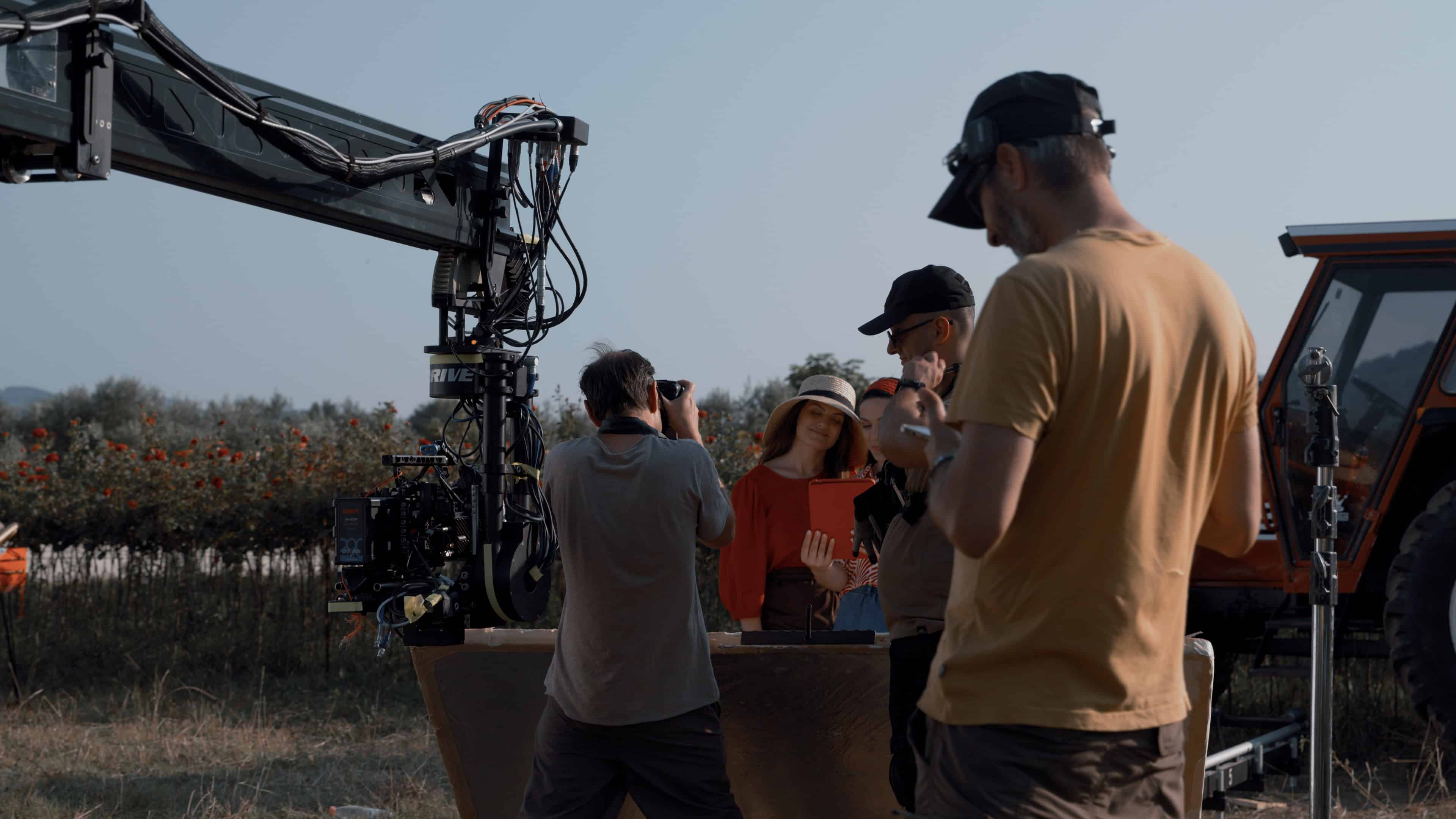
There was a long discussion during the PPM around storyboards and shooting style. Our roster director Mak Akay had a very specific vision: camera choreography as the main storytelling tool. Dynamic movements, intricate shots, and transitions that would weave scenes together into one continuous experience. It was a fresh approach and it genuinely had the potential to elevate the film to an international level.
But the product being sold wasn’t purely emotional. Vodafone’s service in this campaign needed to be understood. It had to be clear enough that the audience could actually follow what the product does and why it matters. For the client, that kind of camera driven storytelling was outside the traditional scope they’d normally use.
So we had to find the golden middle ground: making the director’s vision come true while still meeting the client’s requirements. This is where it really matters that the agency has strong creative leadership. The Chief Creative Officer understood the vision and translated it carefully into “client language.” Compromises were made without risking quality. The dynamism was reduced a little, and the film became more explanatory and product-focused: which, in the end, made sense. The work didn’t lose its ambition, it just became more trustworthy in the way it communicated the service.
That process underlined something I see again and again: when there’s a real creative sparring partner in the room, production doesn’t feel like pushing a boulder uphill. It feels like building something together.

Pre-production: fast, overlapping, and unforgiving
Prep was very fast. We kicked off on the 3rd and had the PPM five days later. The total prep was about one week and we had to do this while also wrapping the previous project, which we had shot only five days before this one started. That overlap is the kind of detail people outside production don’t always notice, but it changes how you operate. You have less breathing room, less time to reset, and you need your team to be mentally agile.
Key decisions had to be locked early:
- The cast and crew had to be confirmed quickly.
- A director and DOP already aligned with the technical approach was a major asset.
- The director and DOP had worked closely together before, which meant communication was fast and clean.
- The production team needed to stay flexible under tight timelines and make smart decisions. Not perfect decisions, smart decisions.
- Because the commercial was location heavy, scouting and agreements became a backbone task. Locations needed to be found, approached, negotiated, confirmed, and papered. All while the rest of the build kept moving.
One thing that was genuinely a relief: having a collaborative director who was open to practical solutions. That changes everything. When a director can adapt without losing the vision, the entire machine runs smoother: across production and every head of department.
The part that needed extra thinking wasn’t only logistics. It was realism. If you’re recreating real life business scenarios: how companies run, how they operate day to day, how customers behave, the details matter. The film aimed for a futuristic, digital look, but the cast, locations, and action still needed to feel natural. That balance is harder than it sounds. If you go too futuristic, it becomes unrelatable. If you go too literal, you lose the ambition of the visual language.
There were also smart swaps that made the plan feasible. Sometimes a DOP wants the best toys available and that’s not wrong. But feasibility is also part of quality. In this case, sourcing equipment solutions that met the creative need without breaking the shoot was essential: for example, using a techno dolly instead of a techno crane. Not the exact same tool, but the right solution in context.
Filming locations in Albania: diversity, proximity, and specific requirements
This project is a great example of the diversity of filming locations in Albania. Not in the abstract “Albania has mountains and beaches” way, but in the very practical way: you can access strong interiors and striking exteriors without turning your schedule into a travel itinerary.
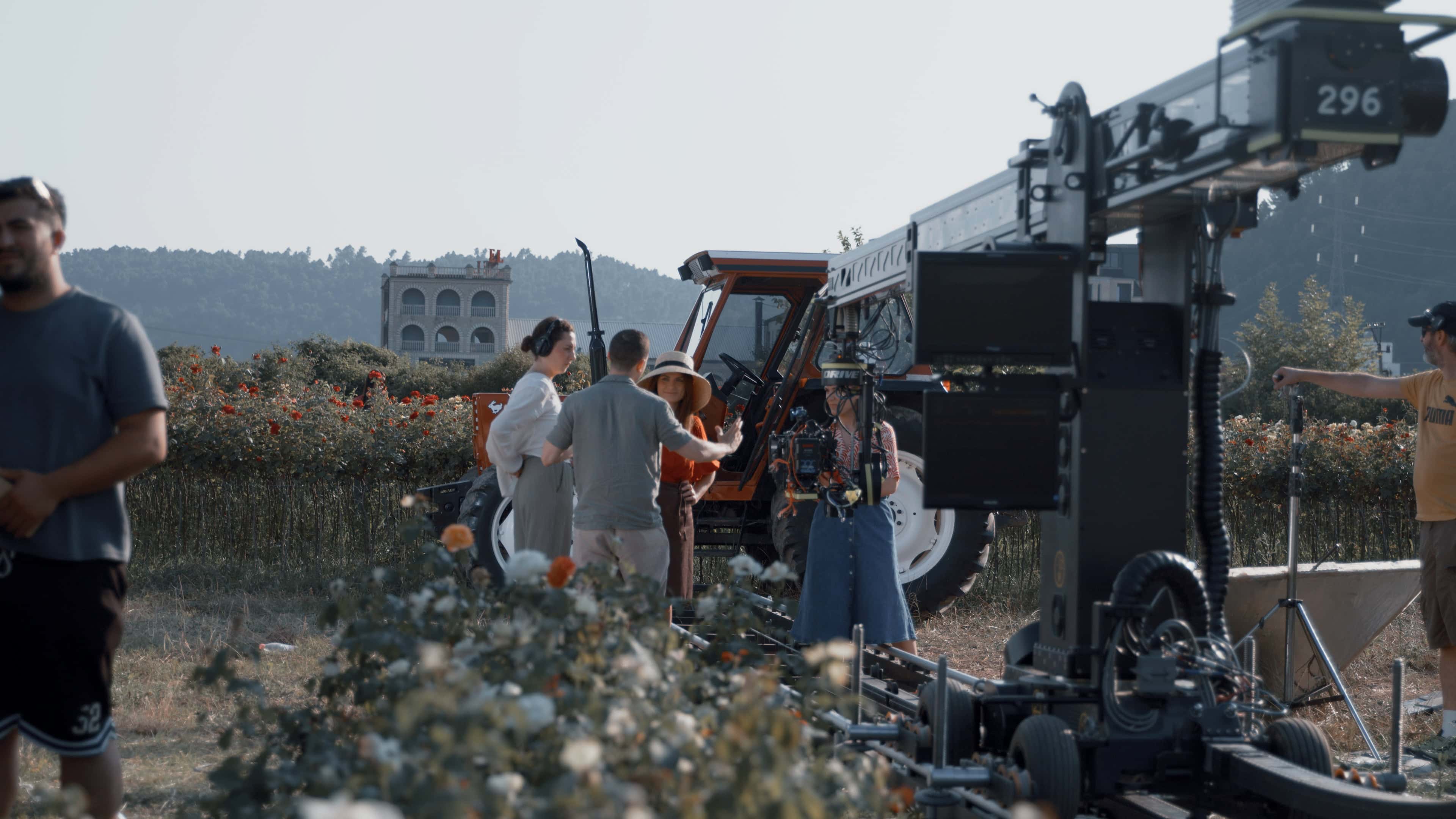
We had beautiful interiors like the office and the bar, alongside urban and rural landscapes like Air Albania Stadium and the flower field.
There was one detail the client and agency were very clear about: building a “red world,” but with a smart and considered use of red. Not constant red everywhere. That meant finding locations that naturally carried the palette, not relying on post or props alone.
As Albanians, we took that part very seriously 🇦🇱
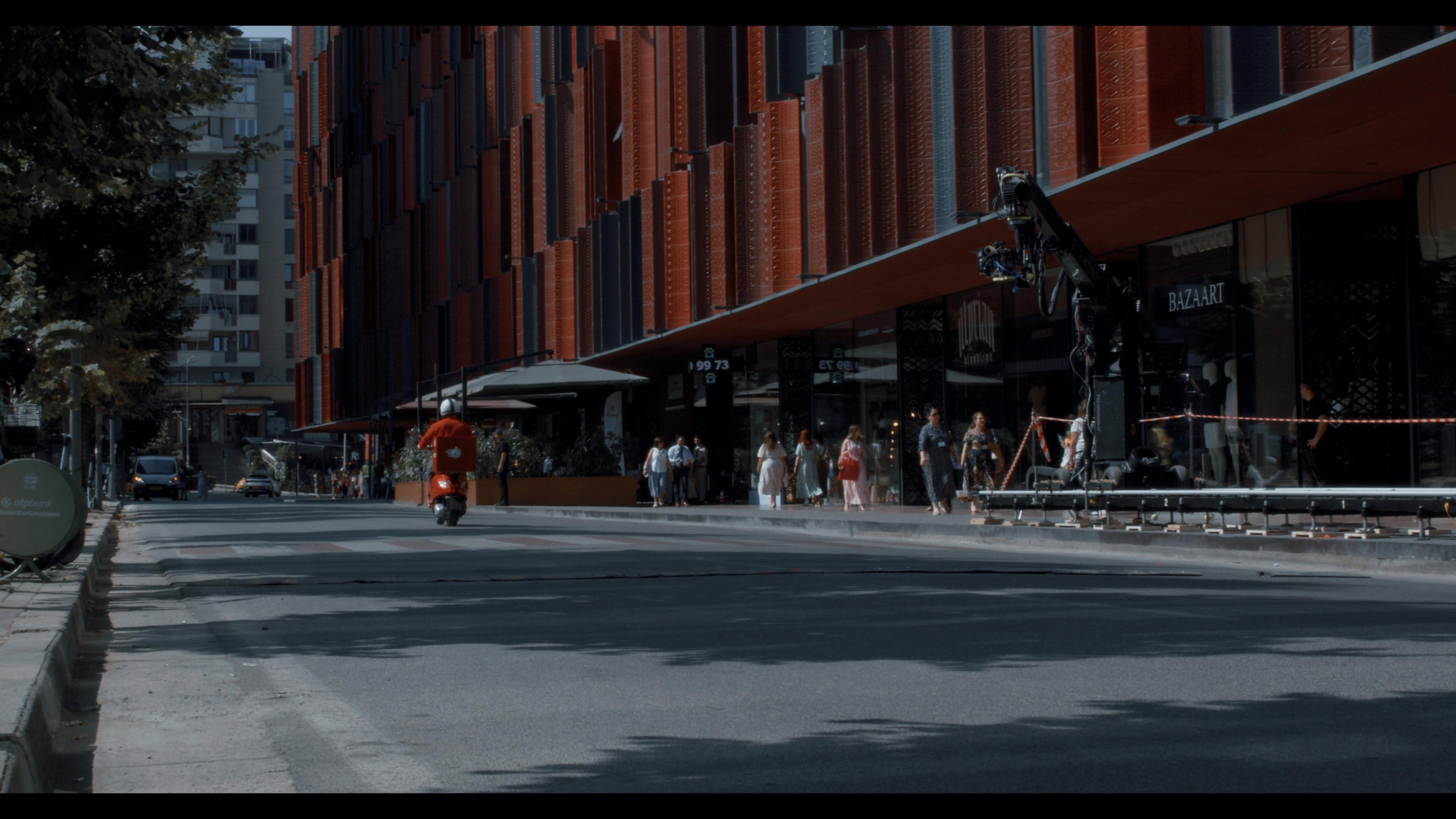
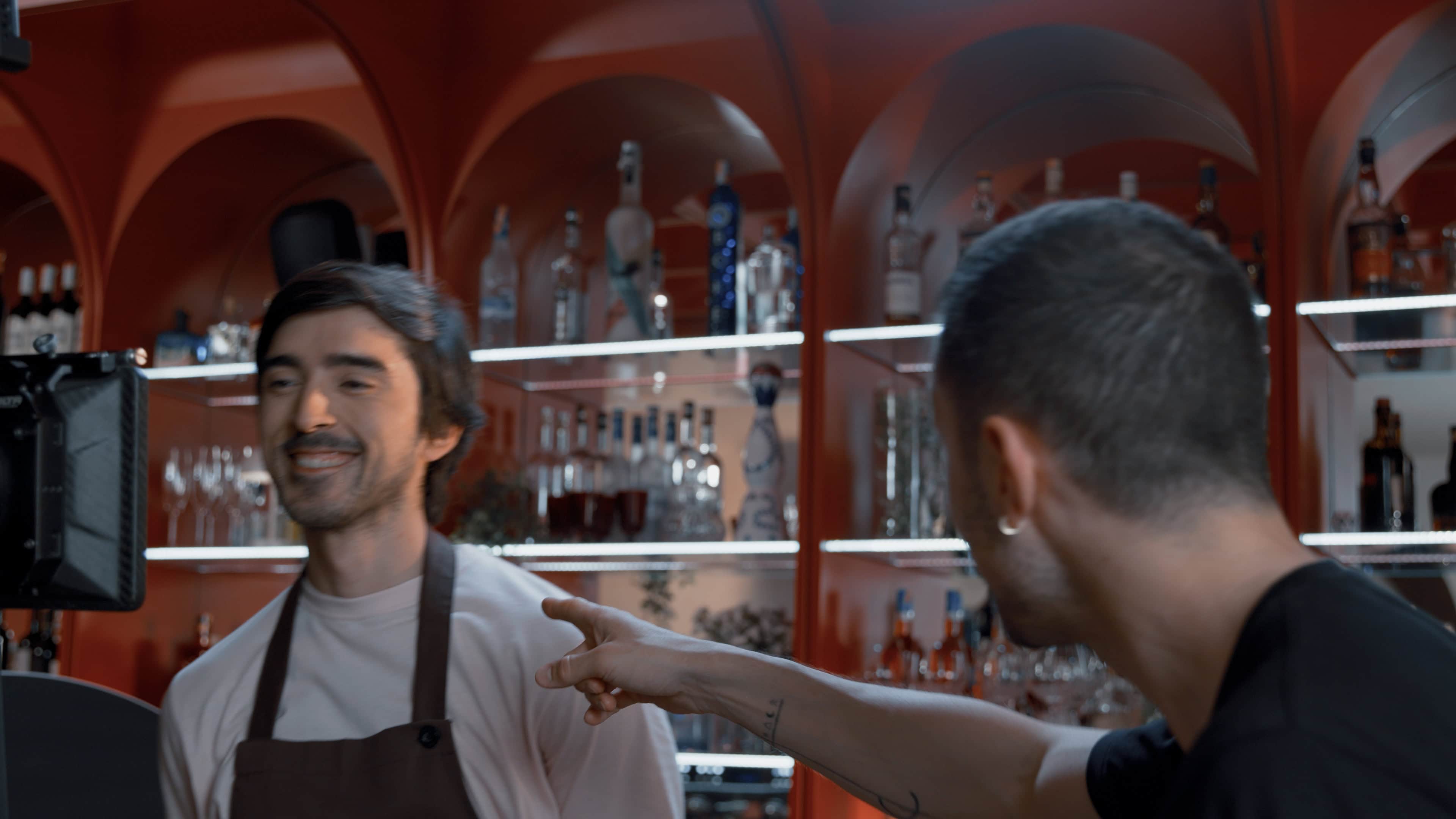
The first idea was to shoot the street scenes at Air Albania Stadium. One of the most iconic red buildings in the city, and also a perfect opportunity to show Tirana’s modern architecture. Then we somehow found the reddest bar I’ve ever been to. The owner was very patriotic. The space was tight and parking was genuinely a nightmare, but it was worth it for that bar counter.
The office scenes were shot at the new Innovation hub inside the Pyramid of Tirana. A very production friendly location with the facilities you need and a collaborative crew.
And then the cherry on top: the red roses flower field. An entire field. In a season when nothing blooms. In a country that mostly imports flowers. That location happened thanks to my producer Blerta, who besides being on top of everything, also happens to buy flowers for her mum, whose name is Rose. Safe to say, our director was lucky to work with people as slightly crazy as us.
Location flexibility helped the schedule and the budget in a very simple way: proximity. Having access to diverse locations within close driving distance allowed us to move quickly and stay efficient without compromising the visual ambition. That’s something I genuinely love about Albania. It’s not only a 30 minute drive from the city if you want a short beach holiday, it can also supply mountains, beaches, urban variety, and landscapes that feel surprisingly different from each other within a manageable schedule. In production language: Long unit moves = production managers nightmare.
The surprise you don’t schedule: 8,000 Jehovah’s Witnesses
Surprises in production? Nooo. What are you talking about?
On the exact day of our shoot at Air Albania Stadium, 8,000 Jehovah’s Witnesses organised an international convention. That meant nearly half of the stadium’s capacity was peacefully walking down the same street where we were shooting a motorcycle scene with a technodolly.
It wasn’t chaos, but it was definitely a situation. It changed the street dynamics, it changed how we had to think about timing and safety, and it reminded us that you can plan everything and still meet something completely outside your control. Production doesn’t reward panic: it rewards clear coordination. We worked around it, stayed respectful, and kept moving. Truly a blessed day for production.

Set life: heat, pace, and a crew that knows each other
We were filming in June, which meant the weather was very hot. I usually prefer heat, but maybe not when you’re shooting in tight spaces with 40–50 people. Even with the overbearing heat, the crew was incredibly professional and stayed on course.
Our director had an optimistic approach to everything, and that energy spreads. The atmosphere stayed high spirited, the crew felt united, and there were ongoing set jokes throughout the production.
Working in a country as small as Albania means crews often know each other very well. They aren’t just co-workers. They’ve crossed paths for years. People are welcoming, communication is direct, and the social fabric of the crew actually helps the work. I’ve worked with most of this crew for many years, and by now we really do operate like a well oiled machine.
The pace of shooting was quick because the idea was ambitious and because two shoot days disappear fast even without heat. But with heat, it can feel endless. The days had that “sauna” quality: you’re moving constantly, you’re focused, you’re drenched, and you’re trying to keep everyone sharp.
The pressure moments were real, and they were mostly about time and parallel problem solving.
While we were shooting in Tirana, my producer Blerta headed to the next location: the flower field. She has this fifth sense for anticipating where trouble will appear. While we were still shooting, she called to tell me the technodolly truck had been stuck in the mud at the field and she was sorting it. That parallel action saved us time because it was happening while we were wrapping in Tirana, not after.
Because of the short turnaround, some art department concepts couldn’t be tested in advance the way you’d normally like. The art department executed incredibly well given the time, but there was a “surreal” shot concept: many receipts stacked up to the ceiling that looked strong on the storyboard and then “felt off” when it appeared live on camera. More importantly: the client and agency saw it live and there was immediate consensus that it needed adapting. Thanks to the quick creative thinking of our director and art department, the shot was adjusted on the spot. The result speaks for itself and it happened under pressure, in the heat, without losing the day.
Agency and client interaction also shaped the rhythm. One thing I witnessed very clearly: it’s incredibly important for the client to be on set. Even when an agency knows their client well, the stakes are high, budgets are being spent, and many people are gathered to execute something that will represent the brand. This shoot was on a weekend, and the client could only attend sporadically. That meant decision making responsibilities sat fully with the agency. They mastered it wonderfully, but it did slow the process. Sometimes a decision takes one minute when the client is there and half an hour when you need to call, explain, align, and wait.
Hybrid workflow: how we kept momentum into post
Considering the quick turnaround, things went very well. Not because there were no challenges, but because the team stayed ready to act. That, to me, is the beauty of production: being a creative problem solver and building the muscle to respond without freezing.
On set, our director Mak Akay and the DOP Miguel Carmenes were highly aware of the impact shots would have in post. They consistently shot plate shots and simple alternatives “just in case.” Those are the details that don’t feel exciting on set, but in post they can mean the difference between a solvable problem and a nightmare.
Workflow wise, it helped immensely that post-production met in advance. There were close to ten people involved across post in Vienna, and having them on call during the shoot was extremely useful when doubts came up. Our main editor effectively also functioned as a post producer, acting as a liaison between the various positions and keeping the chain moving which sped everything up.
We also had an editor on set assembling what we shot and sending proxies to our post team. That real-time assembly loop reduces risk. It allows you to spot potential issues early, and it gives post a head start instead of waiting for the shoot to end.
From kick off to delivery: 3 weeks
From idea to delivery, the turnaround was roughly three weeks. What enabled the speed wasn’t magic: it was communication and relationships.
What stayed with me most was a familiar realisation: in production, challenges often feel overwhelming in the moment and can introduce doubt, especially under pressure. When timelines are tight and decisions stack up quickly, even small obstacles can feel heavier than they are.
But there are rarely single solution problems. There are usually several ways forward, and what matters most is the determination to keep going, to adapt, and to choose progress over hesitation. That mindset of staying practical, continuing to move, and trusting the process, is ultimately what allows a production to reach a successful outcome.
And yes, sometimes it really is a masterclass in controlled panic.
Watch the final behind the scenes film here.
Written by Frenki Veshi, Production Manager Caravan
